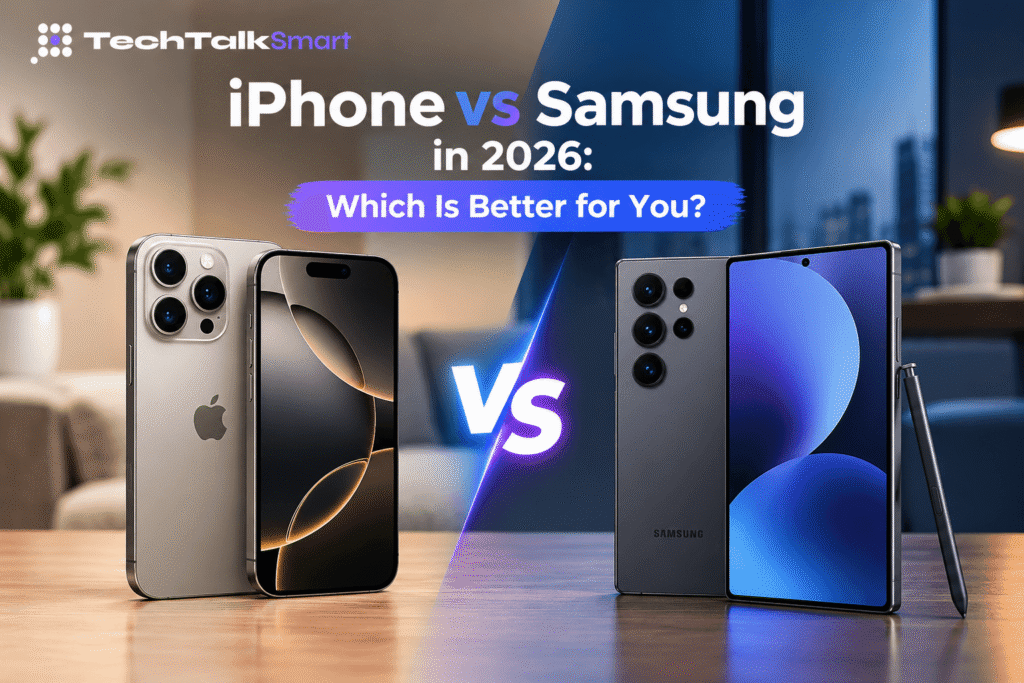
Every few months someone in my family asks me the same thing: “Should I just buy an iPhone, or is Samsung fine?” My cousin asked last week. My neighbour asked at a wedding, with a plate of paneer in his hand. And honestly, the answer I give changes depending on who is asking.
That’s the thing nobody tells you about the samsung vs iphone debate. Both brands make excellent phones now, and Indians are clearly buying them. In April to June 2026, Samsung held roughly 17% of India’s smartphone shipments and Apple around 10%, even though the whole market shrank by 13% that quarter. Apple actually grew in that stretch, shipping about 3.5 million iPhones against 3.1 million a year earlier, which is a 12% jump (all of it per Omdia’s Q2 2026 India report). So no, you’re not the only one stuck on this decision. The gap that existed five or six years ago, where one clearly beat the other in some area, has mostly closed. What’s left is a set of trade-offs, and which ones matter depends on how you actually use your phone, not on what a spec sheet says.
So this is a proper iphone vs samsung comparison, written for people in India who just want to pick one and stop worrying. I’ll tell you where each one wins, where it annoys me, and who should buy what.
iPhone vs Samsung: What’s the Difference?
Start with the big picture. Apple makes the hardware, the chip and the software, all together. Samsung makes the hardware and a lot of its own components, but runs Android with its own layer (One UI) on top. That one difference explains about 70% of everything else you’ll read below.
Apple’s approach means fewer choices but a tighter, more predictable experience. Samsung’s approach means more variety, more features crammed in, and a much wider price range, from a ₹10,000 phone to a foldable that costs more than some bikes.
Here’s a quick side-by-side before we go deeper.
| Area | iPhone | Samsung Galaxy |
| Operating system | iOS | Android with One UI |
| Price range in India | Mid to very high | Low to very high |
| Camera approach | Consistent, natural, great video | Detailed, punchy, strong zoom |
| Charging | Slower wired, MagSafe wireless | Faster wired on most models |
| Customisation | Limited, improving | Extensive |
| Software support | Long, usually 6-7 years | Up to 7 years on recent flagships |
| Resale value | Very strong | Decent, drops faster |
| Foldables | No (not yet) | Yes, Z Fold and Z Flip |
| Best for | Simplicity, video, ecosystem | Flexibility, variety, value |
Don’t treat that table as gospel. Plenty of exceptions exist, especially in cheaper Samsung models. But it gives you the shape of things.
iPhone vs Samsung Camera Comparison: Which Takes Better Photos?
I’ll say it upfront: you’ll be happy with either. If someone claims one of these cameras is “bad”, they’re probably comparing a ₹15,000 phone to a ₹1,50,000 one.
Photo Quality and Colour Accuracy
iPhones tend to go for a natural, slightly muted look. Skin tones look like skin. Skies look like skies. It’s consistent, which is the real selling point; you can point and shoot in any mood and get roughly the same result every time.
Samsung leans the other way. Colours are punchier, greens pop, blues get a little extra love, and the image is often sharper out of the box. Some people adore this. Others (me, on some days) feel it looks slightly “processed”. When you put a samsung galaxy vs iPhone shot side by side on a social feed, the Samsung one often catches the eye first, while the iPhone one looks more like what you actually remember seeing.
Neither is wrong. It’s taste.
Video Recording: iPhone vs Samsung
Here, the iPhone still has an edge, and I don’t think it’s even that close for casual shooters. The stabilisation is smooth, the colour stays consistent when you move from a bright window to a dark corner, and the audio is clean. Plenty of YouTubers and filmmakers use iPhones as a B-camera for exactly that reason.
Samsung’s video has improved a lot, and the high-end models can shoot in 8K and offer plenty of pro options. But exposure sometimes shifts mid-clip, and I’ve noticed the processing can get a bit heavy-handed in low light. If video is your main thing, lean iPhone. If it’s mostly photos, the gap shrinks.
Zoom and Night Photography
This is where Samsung’s top models shine. The long-range zoom on the Ultra phones is genuinely absurd. You can photograph a distant signboard or a bird on a wire and still get something usable. iPhones have good zoom too, but they usually stop short of what Samsung offers at the very top.
At night, it’s tighter. Both brands use clever processing to brighten dark scenes. Samsung often makes the image brighter and more detailed, while iPhone keeps it truer to the actual mood of the scene. If you love a moody, realistic night shot, iPhone. If you want everything visible and sharp, Samsung.
Which Phone Is Better for Instagram, TikTok and YouTube?
Short answer: iPhone for video-first creators, Samsung for photo-first ones.
For Reels and YouTube, the iPhone’s steady footage and reliable colour save a lot of editing time. For Instagram photos, Samsung’s punchy look needs less filtering. Also, a lot of editing apps and applications get new features on iOS first, which is a small but real perk if you edit on your phone. (TikTok itself is a tricky one in India, so most creators here are on Reels and Shorts anyway.)
iPhone vs Samsung Battery Life and Charging
Battery is the least glamorous part of buying a phone and the one you’ll feel every single day.
Which Phone Lasts Longer on a Single Charge?
It depends on the model, but generally the recent iPhones have gotten very good here. Apple’s chip is efficient, and the software is tuned tightly to it, so standby drain is low and a day of heavy use is rarely a problem.
Samsung’s bigger phones carry large batteries too, and a Galaxy Ultra will easily get you through a full day. Smaller and cheaper Samsungs vary more. I’ve used mid-range Galaxy A phones that lasted two days and others that needed a top-up by evening. With iPhones, there’s less lottery involved.
One thing worth saying: battery health over time matters as much as day-one numbers. Both brands let you check it in settings, and both do decently after a couple of years. Nothing dramatic here.
Charging Speed and Wireless Charging
This is a fair point for Samsung. Most Galaxy phones charge faster by wire than iPhones, especially the cheaper ones, which sometimes charge quicker than an iPhone that costs three times as much. Slightly silly, but true.
iPhones have the MagSafe and Qi2 charging system, which is honestly lovely. The magnetic snap, the accessories, the car mounts, the little wallets. Wireless charging works well on both, and both can charge other devices a bit in a pinch. If you hate waiting at a socket, Samsung wins on raw speed. If you like the accessory world, Apple’s ecosystem is hard to beat.
iPhone vs Samsung Performance: Which Is Faster?
Speed is the thing everyone asks about and almost nobody can actually feel anymore. A decent flagship from either side opens apps in a blink, scrolls without a hitch and handles UPI, reels and a dozen open tabs without breaking a sweat. The differences show up later: after a year of updates, in a long gaming session, or when you’re juggling six things at once and the phone has to keep up. So instead of quoting benchmark scores that mean little at a chai stall, here’s how the two really behave in daily life.
Processor, RAM and Everyday Performance
Apple’s chips are, to put it plainly, ahead in single-core speed. Benchmarks keep showing this year after year. In everyday use, though, you won’t feel it. Opening apps, scrolling, switching between tabs: both feel instant on a flagship.
Samsung’s flagships run Snapdragon chips (or Exynos in some regions), and they come with more RAM on paper, often 12GB where Apple uses less. Android uses memory differently, so those numbers aren’t directly comparable. What matters is how it feels after a year or two. iPhones tend to age gracefully; Samsung flagships do too, but cheaper Galaxy models can start to stutter sooner.
Which Is Better for Gaming?
Both are very good. Apple’s chip and tight optimisation mean heavy games run smooth and stay consistent, with fewer thermal surprises on newer models. Samsung’s flagships are great as well, often with higher refresh rate screens and cooling tricks.
In India, the practical difference is this: BGMI, Free Fire and Call of Duty Mobile run well on both. Some games get updates or features a bit earlier on one platform, but that’s a coin flip. If you want a gaming phone, a Samsung flagship or an iPhone Pro will both serve you fine. Budget Samsungs will struggle with the heaviest titles, as would any budget phone.
Which Phone Is Better for Heavy Users?
If you juggle many things at once, it depends on how you juggle. Samsung’s multitasking is more flexible: split-screen, pop-up windows, and DeX, which gives you a desktop-style mode when you plug into a monitor. The S Pen on Ultra models is a proper productivity tool, too.
iPhone is simpler and smoother for moving between tasks, but it’s more rigid. For someone who lives in their phone all day, doing a bit of everything, I’d lean Samsung for flexibility. For someone who wants it to just work without thinking, iPhone.
iOS vs Samsung One UI: Which Operating System Is Better?
This is the part people undervalue when they buy. You can love a camera for a week, but you live inside the software for years.
Ease of Use and User Experience
iOS is clean and consistent. Nearly everything works the way you’d guess. Settings are where you’d expect them. Your parents can use it without a tutorial, and I mean that as a compliment.
One UI has gotten much better over the years. It used to feel cluttered; now it’s tidy, smooth and packed with useful extras. There’s a bit more to learn, and the sheer number of options can overwhelm some people. But if you like poking around, you’ll find stuff you’d miss on an iPhone.
Customisation and Personalisation
Samsung wins here, clearly. Custom launchers, widgets that you can place anywhere, themes, icon packs, always-on display options, side-loading apps. You can make it look and behave however you like.
iPhone has opened up. You can now rearrange the home screen more freely, change icon tints and use lock screen widgets. It’s better than it used to be, but still more tightly controlled. If you enjoy tinkering, Samsung is the happier home. Apple fans will argue that limits are a feature, and for many people they’re right.
When it comes to apps and applications, the stores are different too. The App Store is more locked down and curated, so you’ll see fewer sketchy options. The Play Store has more choice but needs a little more care. Both have everything you’d need for UPI, banking, food delivery and the rest.
Software Updates and Long-Term Support
Samsung changed the game here. Recent flagships now get up to seven years of OS and security updates, which matches or beats what Apple has traditionally offered. That’s a big shift from the old “Android phones get abandoned” reputation.
Apple has long been the leader in this area, and iPhones still typically get around six or seven years of updates. The difference is that on iPhone, every compatible phone gets the update on day one. On Samsung, the promise is strong for flagships and newer mid-rangers, but older or cheaper models can lag. Check the specific model before you buy.
Switching from iPhone to Samsung or Samsung to iPhone
Moving across is easier than it used to be. Apple has a “Move to iOS” app, and Samsung has Smart Switch. Both will carry over contacts, photos, messages and many of your apps. You might lose some app data, and WhatsApp chats take an extra step but are doable.
The part that really bites is the ecosystem. If you have an Apple Watch, AirPods, a MacBook and iMessage-loving friends, leaving costs you convenience. If you’re deep into Samsung’s Galaxy Watch, Buds and tablets, the same applies the other way. Think about what you own before you jump.
Apple Intelligence vs Samsung Galaxy AI: Which Is Better?
AI is everywhere in phone ads now, and it all sounds magical until you try it at home. Apple has gone slow and careful, Samsung quick and a bit scattered, so here’s what each one actually does for you.
AI Writing, Search and Productivity Tools
Apple Intelligence gives you writing tools (rewrite, proofread, summarise), notification summaries and a smarter Siri that’s still being built out. It’s polished and fits neatly into the system, but it’s more cautious.
Samsung’s Galaxy AI got a head start and feels broader. Live Translate for calls, note summaries, transcript tools and Circle to Search (which lets you search anything on screen by circling it) are genuinely handy. In day-to-day use, I find Samsung’s AI tricks more varied, though Apple’s feel cleaner.
AI Photo Editing and Creative Features
Both can remove unwanted objects from photos, clean up backgrounds and generate stickers or images. Samsung’s editing tools are a bit more aggressive and flexible. Apple’s feel more restrained and tend to keep photos looking natural.
Honestly, for most people, this is a “nice to have”. I’d not buy a phone only for AI photo editing, because both brands do a fair job and the features keep changing.
Privacy, Language Support and Availability
Apple pushes privacy hard, doing a lot of work on the device itself, and that’s a real selling point if you care about it. Samsung also processes many features on the device, but some use cloud processing, and a few features may come with conditions or later become paid.
Language support matters a lot in India. Both brands have been adding more languages, including Hindi and other Indian languages, but coverage differs by feature and changes often. Before buying, check which features work in your language on the exact model you want. Don’t just trust the ad.
Also Read: 15 Mobile App Development Tips to Build a Successful App in 2026
iPhone vs Samsung Price Comparison in India
Money is where this debate gets real, because the price tag decides things long before the specs do. Samsung covers almost every budget, while Apple plays mostly in the upper half, so let’s see what you actually get for your rupees.
Which Brand Offers Better Value for Money?
Samsung, in most cases, gives you more hardware per rupee. Bigger batteries, faster charging, higher refresh rates, more RAM, extra cameras. If you compare specs line by line at the same price, Samsung usually looks better.
But value isn’t just specs. iPhones hold their price better, get long updates and rarely feel sluggish. So the real cost over four or five years can end up closer than the sticker suggests. It depends on whether you’ll resell.
Budget vs Mid-Range vs Flagship Phones
In the budget segment, Samsung has the field almost to itself. You can get a decent Galaxy M or A series phone for well under ₹20,000, while iPhones don’t really exist at that price new.
In the mid-range, things get interesting. Older iPhone models that have dropped in price compete with Galaxy A and S FE phones. If you’re comparing a samsung mobile vs iphone around the ₹40,000 to ₹55,000 range, the iPhone gives you better video and longevity, and the Samsung gives you a nicer screen, faster charging and more features.
At the flagship level, you’re choosing a philosophy. iPhone Pro versus Galaxy S Ultra is a close race, and either is a fine choice.
Discounts, Exchange Offers and Resale Value
Indian shoppers know this game. Festive sales on Amazon and Flipkart, bank card offers, exchange bonuses. Apple sometimes holds firm on pricing, but sale periods often bring real cuts, especially on last year’s model. Samsung drops prices more often and more steeply, which is great for buyers and less great for resale.
Resale is where iPhone shines. A two-year-old iPhone still fetches a respectable price. A two-year-old Samsung usually fetches noticeably less. If you swap phones every couple of years, that gap matters a lot.
iPhone vs Samsung: Which Is Better for Different Users?
Let’s get practical, because the best phone for a college student isn’t the best one for a video editor or a busy manager. Here’s how I’d split it based on who you are and what you do all day.
iPhone vs Samsung for Students
Tight budget? Samsung, easily. You get a solid phone for much less, and the battery and charging are good for long days. If your family is already on Apple, or you can find a discounted older iPhone, that also works, especially if you’re getting a MacBook or iPad later.
iPhone vs Samsung for Photography and Content Creation
Video creators, go iPhone. Photographers who want zoom and punchy shots, go Samsung Ultra. If you edit on a Mac, the iPhone fits in neatly. If you shoot at big distances, Samsung’s zoom is hard to ignore.
iPhone vs Samsung for Business and Productivity
This one’s close. iPhone has excellent security, smooth email and calendar handling, and a nice link to Mac. Samsung’s DeX, multitasking and S Pen are better for people who really work from their phone. Samsung also has Knox, a solid security layer for company use.
iPhone vs Samsung for Gaming
Both are good. Pick iPhone for consistent performance, pick Samsung for the bigger, faster screens and cooling options. Don’t overthink it.
iPhone vs Samsung for Everyday Use
If you just call, scroll, watch videos, use UPI and take family photos, either is perfect. Choose based on budget, what your friends and family use, and which design you like holding. Really.
iPhone vs Samsung Pros and Cons
If you skipped straight to the end, this is the short version of everything above. No phone ticks every box, so here’s what each one does well and where it lets you down.
iPhone: Pros
- Smooth, consistent software
- Excellent video quality
- Strong resale value
- Long update support
- Great ecosystem with Apple devices
iPhone: Cons
- Costly, especially in India
- Slower charging
- Less customisation
- Fewer budget options
- Repairs can be expensive
Samsung: Pros
- Huge range of prices and styles
- Fast charging on many models
- Flexible customisation
- Impressive zoom and display quality
- Foldables, S Pen and DeX
Samsung: Cons
- Resale value drops faster
- Cheaper models can slow down over time
- Some software clutter and pre-installed extras
- Camera processing can look over-done
- Update quality varies across models
Also Read: 15 Best Mobile App Development Tools in 2026: Features, Benefits & Comparison
Conclusion
So, who wins? Neither, and I know that’s the annoying answer. But it’s the honest one. Buy an iPhone if you want a simple, steady phone with great video, long life and strong resale. Buy a Samsung if you want more features, more choice, faster charging and better value at nearly every price point.
My own rule of thumb is this: if you’re already inside Apple’s world, stay. If you love fiddling with settings or you’re on a tighter budget, go Samsung. If you’re truly stuck, hold both in a shop for five minutes, and see which one feels right in your hand. That tiny moment tells you more than any review, including this one.
The iPhone vs Samsung question will keep coming back every year with new launches, and that’s fine. For more honest, no-nonsense phone guides, keep an eye on Tech Talk Smart, the tech blogging website where this article lives. We’ll keep testing, comparing and writing so you can pick your next phone without the headache. Tech Talk Smart is here for exactly this kind of decision.
FAQs
Is iPhone better than Samsung in 2026?
Not universally. iPhone is better for video, simplicity and resale. Samsung is better for variety, charging speed, customisation and value.
Which phone has the better camera?
iPhone for video and natural colours. Samsung for zoom and punchy photos. Both are excellent for everyday shots.
Which lasts longer, iPhone or Samsung?
Both can last well. iPhones are very consistent, and recent Samsung flagships get up to seven years of updates, so either can serve you for years.
Is Samsung cheaper than iPhone in India?
Yes, in most segments. Samsung offers phones at every price, while iPhones start higher. Older iPhones on sale narrow the gap.
Which has better resale value?
iPhone, by a fair margin. They hold their price much better than Samsung phones.
Is Samsung Galaxy AI better than Apple Intelligence?
Galaxy AI feels broader right now, with more tools. Apple Intelligence feels cleaner and leans on privacy. Check language support for the exact model.
Which one is better for gaming?
Both run popular games smoothly. Flagship models from either brand are great, while budget Samsungs may struggle with heavy games.
Can I switch easily between iPhone and Samsung?
Yes. Apple’s Move to iOS and Samsung’s Smart Switch transfer most things, though some app data and ecosystem perks may not carry over.
 Add us as a preferred source on Google